Around the Organization (ATO)
Frameworks for Functional Role Clarity and Strategic Growth
Chief Corporate Affairs Officer (CCAO) Persona Framework

Welcome to the Chief Corporate Affairs Officer (CCAO) segment of our Around the Organization (ATO) practice—an area where we encourage a deeper understanding of organizational roles and functions for enhanced clarity, decision-making, and collaboration. Dive into the unique characteristics, challenges, and future evolution of the CCAO role.
Learn how CCAOs shape and protect the organization’s reputation, navigate complex regulatory landscapes, and foster strong relationships with key stakeholders. Discover the critical role CCAOs play in aligning corporate strategy with public perception, managing crisis communications, and driving the company’s social responsibility initiatives.
The Framework
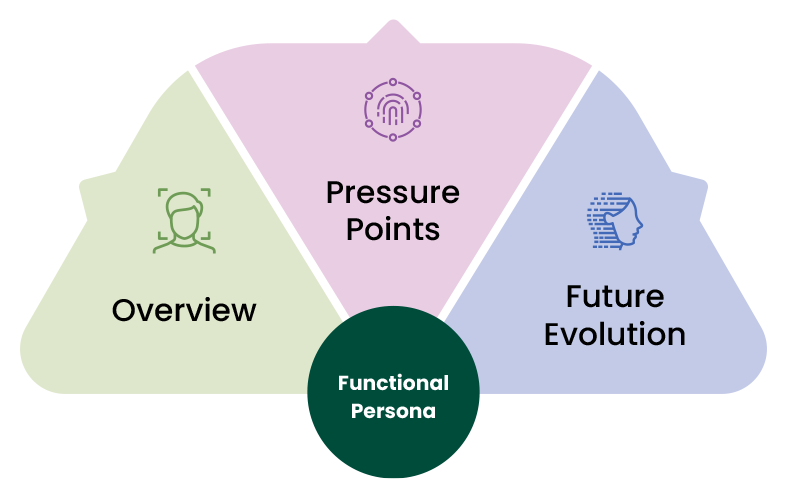

The overview takes a deeper dive into the functional persona by integrating a holistic perspective. This section highlights the unique characteristics, capabilities, and the central role that the functional persona plays within the organizational ecosystem.

The pressure points highlights the challenges and obstacles that individuals within the functional persona may encounter. The importance of the pressure points is aimed to provide guidance towards the overall wellbeing of the functional persona.

The future evolution considers the ever-evolving landscape of market trends and how they intersect with the trajectory of the functional persona. It does not only forecast, but also aims to prepare and shape the functional persona to the change.
Overview
The Chief Corporate Affairs Officer (CCAO) serves as the enterprise guardian, responsible for architecting and safeguarding the organization’s reputation while steering the complex landscape of relationships and external pressures.
The CCAO has evolved beyond a traditional communications role to become a central strategic pillar in the C-suite, serving as the primary guardian of the organization’s social way they operate. They integrate previously siloed functions including government affairs, public policy, investor relations, tension management, and strategic communications into a unified approach that manages the organization’s entire external-facing posture. Operating as the trusted counselor to the CEO, the CCAO brings an essential “outside-in” perspective to strategic decision-making, scanning the horizon for emerging tensions and opportunities that might impact organizational reputation. This role looks for exceptional business acumen to translate complex partnership dynamics into actionable strategic guidance. The CCAO looks to steer through the overlapping environment where geopolitical instability, societal polarization, and technological disruption create perpetual challenges. Their strategic foresight ensures the organization maintains partner and collaborator trust and operational resilience through transparency.
Role Attributes
Reputation Stewardship: Architecting and protecting the organization’s most valuable intangible asset across all partnership and collaborator groups
Partner Integration: Managing complex relationships with government bodies, regulators, investors, media, and communities through unified engagement strategies
Strategic Counseling: Providing “outside-in” perspective to the C-suite, anticipating external reactions and ensuring strategic decisions are reputationally resilient
Pressure Points
The CCAO operates within overlapping environments, facing unprecedented complexity as multiple global challenges interact and compound one another, creating a self-reinforcing system of escalating pressures.
The primary pressures facing the CCAO is guiding the often-conflicting expectations of a vast and diverse ecosystem in an era where partner and collaborator capitalism has replaced shareholder primacy. This creates complex scenarios where actions satisfying one group may provoke backlash from another, particularly as societal polarization looks for companies to take positions on sensitive issues. The digital media landscape compounds these challenges, where the 24/7 news cycle and social media algorithms can transform minor operational issues into major reputational crises within hours. The CCAO wants to maintain constant vigilance through horizon scanning while managing greater volumes of messages entirely outside their direct control. Resource constraints create additional pressure as the scope of responsibilities expands dramatically to include ESG strategy, geopolitical analysis, and AI governance, often without proportional increases in budget or staffing. The velocity of information flow compresses response timelines from days to minutes, requiring immediate decision-making under pressure.
Common Pressure Points
Managing conflicting expectations in divided environments
Responding to compressed timelines and misinformation
Developing expertise across expanding domains with constrained budgets
Future Evolution
The CCAO’s role will evolve into a cross-functional integrator of complex non-financial risks, weaving together sustainability, geopolitics, and artificial intelligence governance into a holistic reputational view.
The evolution of the CCAO role represents a fundamental shift beyond functional communications specialist to strategic tension integrator, positioned at the intersection of the most disruptive forces. ESG governance will expand beyond annual reporting to orchestrating comprehensive sustainability strategies that frame environmental and social initiatives as core value creation drivers rather than philanthropic sidebars. Geopolitical intelligence will become central as the CCAO either absorbs responsibilities as Chief Geopolitical Officer or collaborates closely with this emerging role to translate complex international dynamics into actionable corporate strategies. Artificial intelligence governance will require the CCAO to shape public discourse around responsible AI use, developing ethical frameworks and transparency protocols while managing concerns about algorithmic bias and societal impact. The integration of advanced analytics and data-driven decision-making will become essential for measuring reputational impact, tracking sentiment in real-time, and demonstrating clear return on investment for corporate affairs initiatives. Business acumen will be paramount as the CCAO looks to speak the language of commerce fluently, connecting every external engagement activity directly to business value creation or protection.
Role Evolution Aspects
Transitioning from reporting to comprehensive ESG governance
Developing intelligence capabilities for geopolitical disruption anticipation
Architecting ethical frameworks for responsible AI deployment
The Role of Change in the
CCAO Functional Persona
The CCAO serves as the enterprise’s strategic guardian during organization evolution, ensuring the organization maintains partner trust and operational resilience while guiding the organization through complex external pressures. This role seeks exceptional ability to bridge internal organizational culture with external brand perception, acting as both architect of change narratives and steward of authenticity. The CCAO looks to guide the organization through societal disruptions, helping leadership determine appropriate responses to macro-level issues from climate change to social justice while managing the reputational implications of these positions. This involves creating transparency and accountability across all external communications, ensuring consistency between public statements and internal realities. The CCAO’s strategic foresight enables proactive adaptation to emerging stakeholder expectations and regulatory requirements.
For CCAOs, embracing strategic change is essential for maintaining organizational credibility, developing proactive communications, building partner capital, and positioning the enterprise as a responsible leader in an increasingly complex global environment.
How CCAOs Can Be Open to and Maintain Change
Build Integrated Intelligence Systems
Develop monitoring capabilities that track partner sentiment and emerging tension to anticipate change requirements.
Nurture Partner Dialogue
Establish continuous engagement processes with external constituencies to understand evolving expectations and build collaborative relationships
Strengthen Cross-Functional Partnerships
Curate working relationships with C-suite leaders to ensure external perspectives inform strategy and reputation considerations guide decisions.