Conditions for On-Strategy Delivery
Create the operating, relational, and personal conditions that help strategy move into daily delivery without losing how people work, learn, and adapt.
The conditions that allow strategy to become real
On-strategy delivery requires both grounding and movement: the structure to hold the work, and the adaptive behaviours to keep it moving.
Strategy does not become real because it has been announced, mapped, or tracked. It becomes real when the organization has the conditions to absorb it, work with it, and translate it into daily delivery.
This is the work of Adaptive Delivery & Systemic Grounding that is expressed in the COSD frame. The work holds a deliberate tension.
Systemic Grounding creates the structural and psychological base that allows an organization to stay anchored through complexity. It includes operating conditions, decision pathways, trust conditions, relational cadences, and a clear holding environment. Adaptive Delivery creates the movement: the active, iterative behaviours that allow teams and leaders to keep learning, adjusting, and delivering as the work evolves.
This distinction matters because strategy often breaks down in the space between intent and practice. The plan may be clear, but the human system may not yet have the rhythms, role clarity, authority pathways, or relational capacity to carry it.
Without grounding, movement can feel like pressure. Without movement, grounding can become static. On-strategy delivery requires both.
It is also why the language needs to shift. We do not lead with terms like driving execution, change management, resilience, high performance, upskilling, or compliance.
These terms can unintentionally place the burden on individuals, imply “force,” or most importantly reduce complex human-system work to checklists, training plans, or productivity measures. They often describe what organizations want from people, rather than also the conditions people need in order to contribute meaningfully.
Instead, we lean toward language that reflects how strategy is actually metabolized: grounding, anchoring, operating conditions, pathways, role evolution, personal mastery, holding environment, and productive disequilibrium.
These terms help name the deeper work: creating enough stability for people to stay connected to purpose, and enough movement for the organization to keep learning, adapting, and delivering.
In this frame, delivery is not just traditionally framed as “execution.” It is the lived practice of strategy across the organization, the team, and the personal level. It is how high-level direction becomes daily behaviour, how roles evolve with the work, and how the organization builds the capacity to move without losing its centre.
MODEL LEVEL
Organization Level
Create the conditions for strategy to move through the enterprise
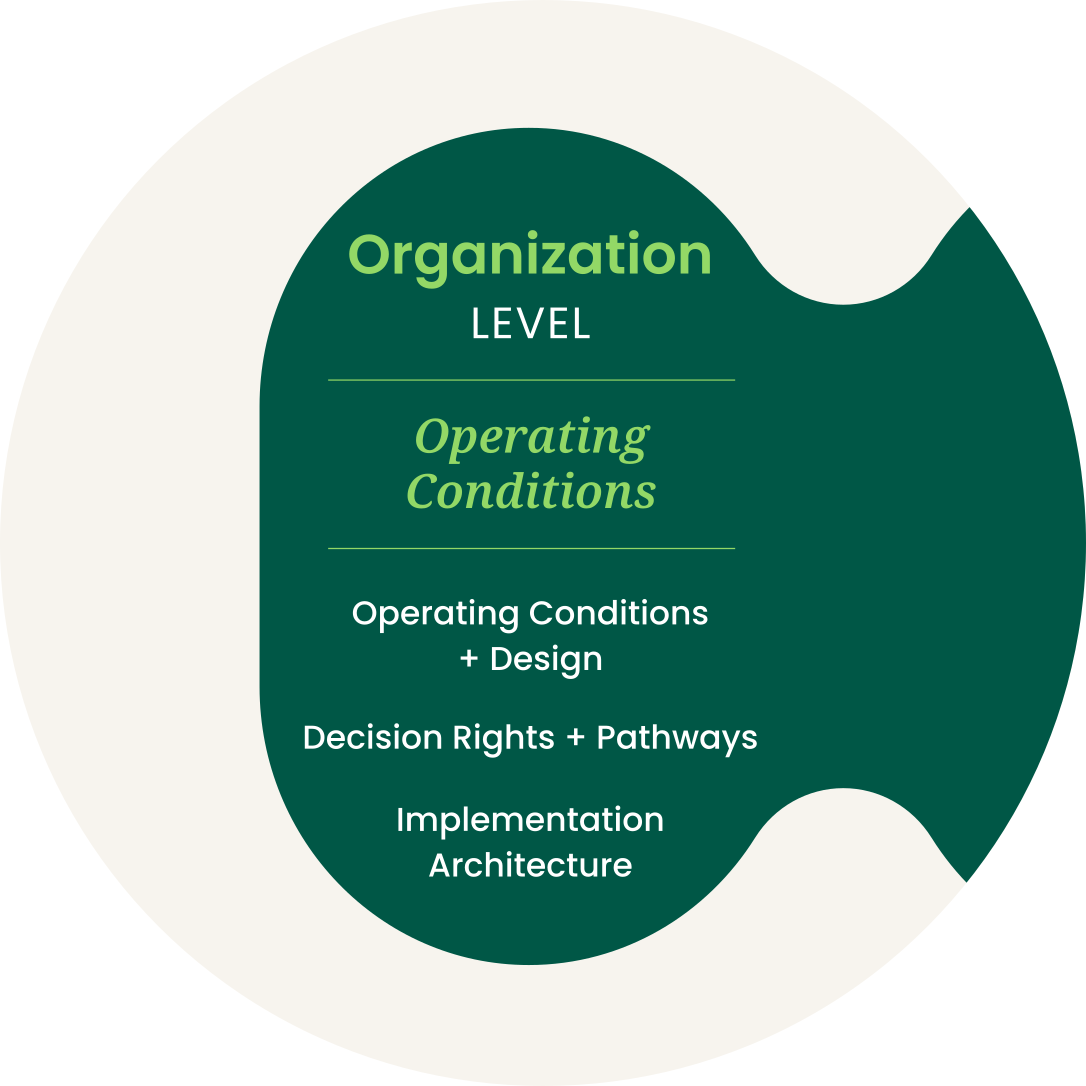
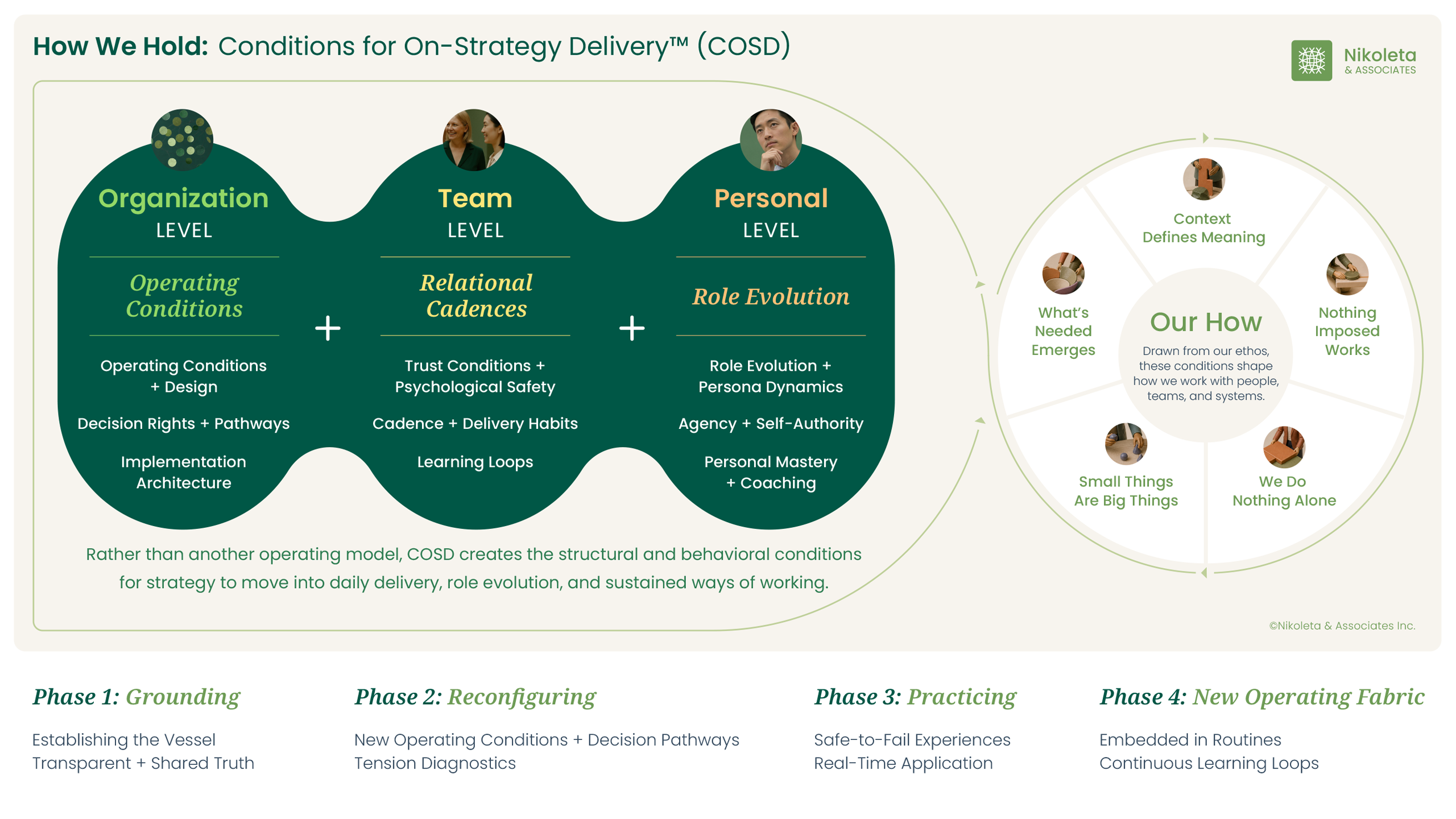
The organization level establishes the operating conditions that allow strategic intent to become usable in daily work. We clarify how work is designed, where decisions sit, and which pathways help people move from direction to action.
This includes operating conditions and design, decision rights and pathways, and the implementation architecture needed to carry the work without turning it into another disconnected initiative.
MODEL LEVEL
Team Level
Build the relational cadence that keeps delivery moving
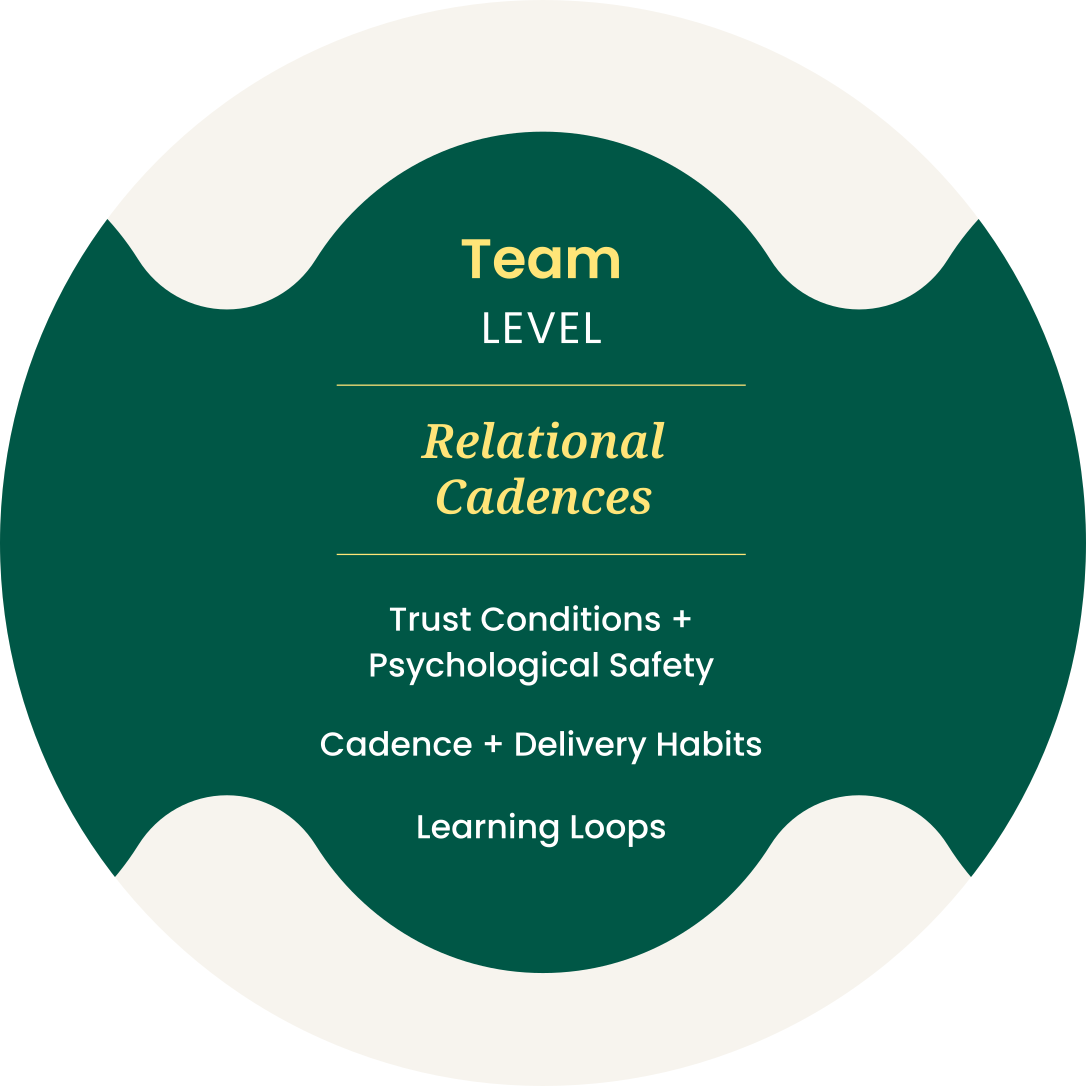
The team level focuses on the trust conditions and delivery habits that help people coordinate through complexity. Strategy moves through teams when cadence, psychological safety, and shared learning are treated as part of the work rather than as side conversations.
We pay attention to relational cadences, trust conditions and psychological safety, delivery habits, and learning loops so teams can keep adapting while staying connected to purpose.
MODEL LEVEL
Personal Level
Support role evolution, agency, and mastery
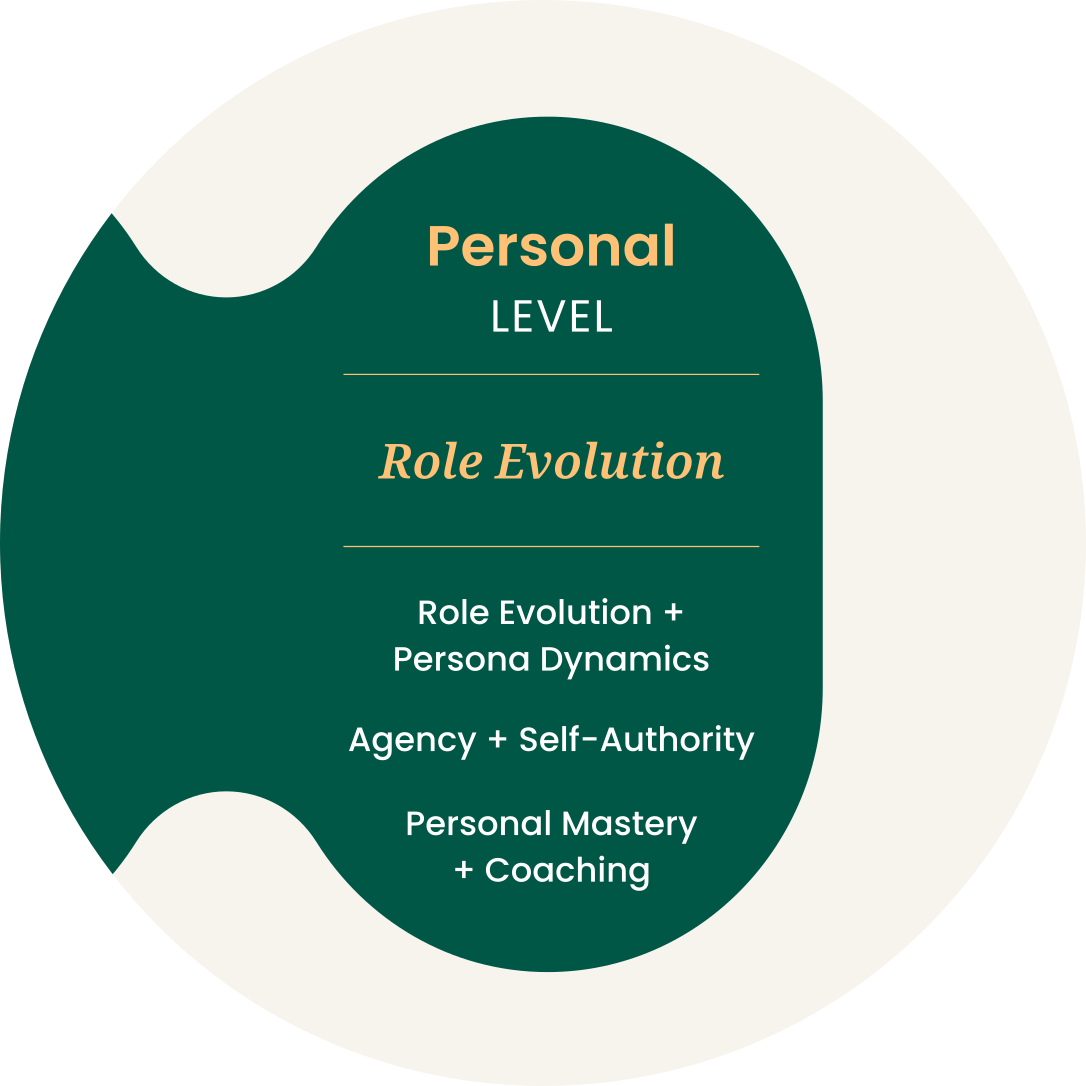
The personal level recognizes that strategy changes what people hold, choose, notice, and practice. Delivery depends on more than role descriptions; it requires people to make sense of their evolving contribution and build the authority to act well.
We work with role evolution, persona dynamics, agency, self-authority, personal mastery, and coaching so individuals can contribute without losing clarity or centre.
Our How
From our ethos, we help create the conditions for a way of working that carries across all our frameworks.

Context Defines Meaning
Context shapes the why, who, and what of a situation, and how it is experienced by each person.

Nothing Imposed Works
Meaningful change happens through trust, relationship, and shared understanding.
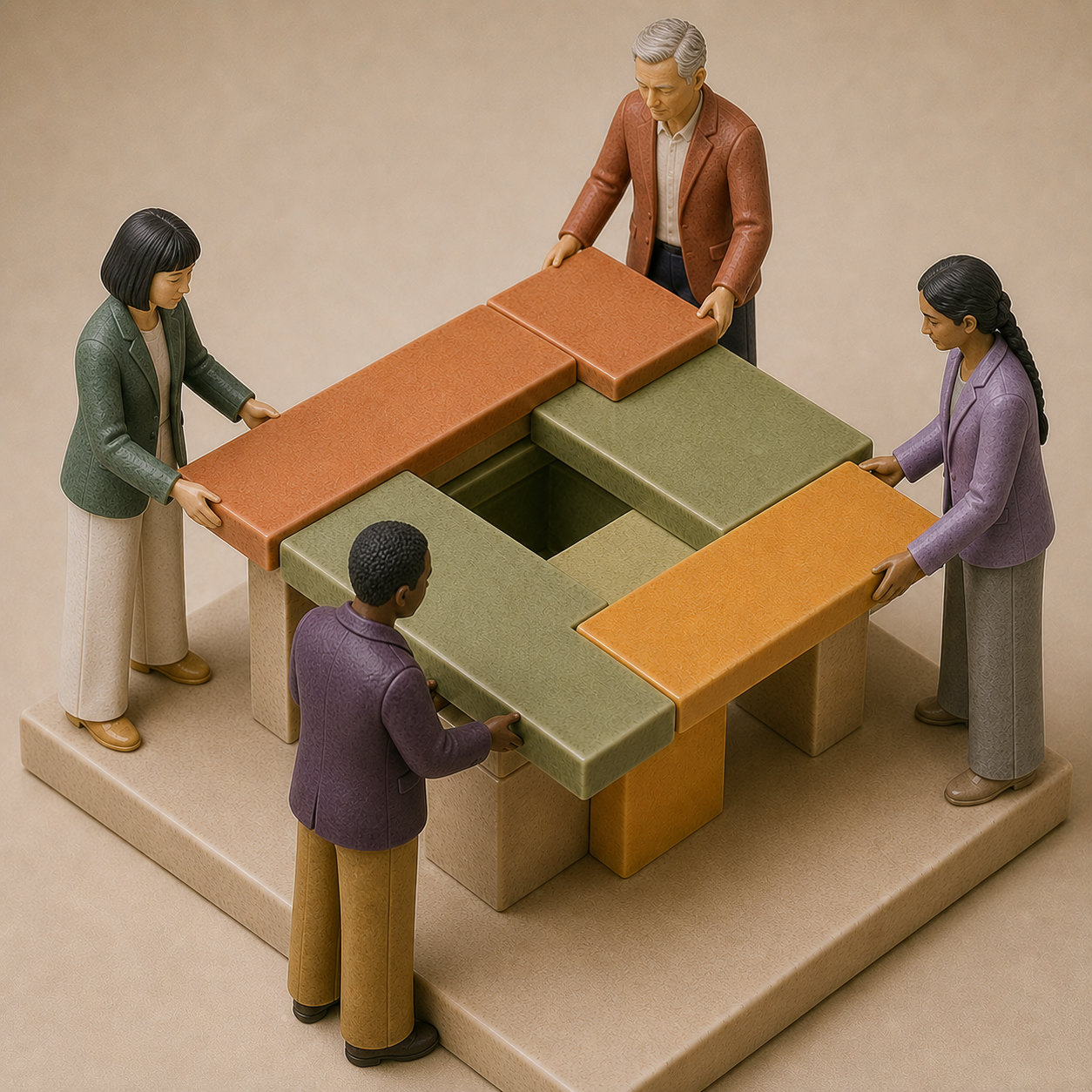
We Do Nothing Alone
Interdependence is at the core of co-creation, connection, and how we work with others.
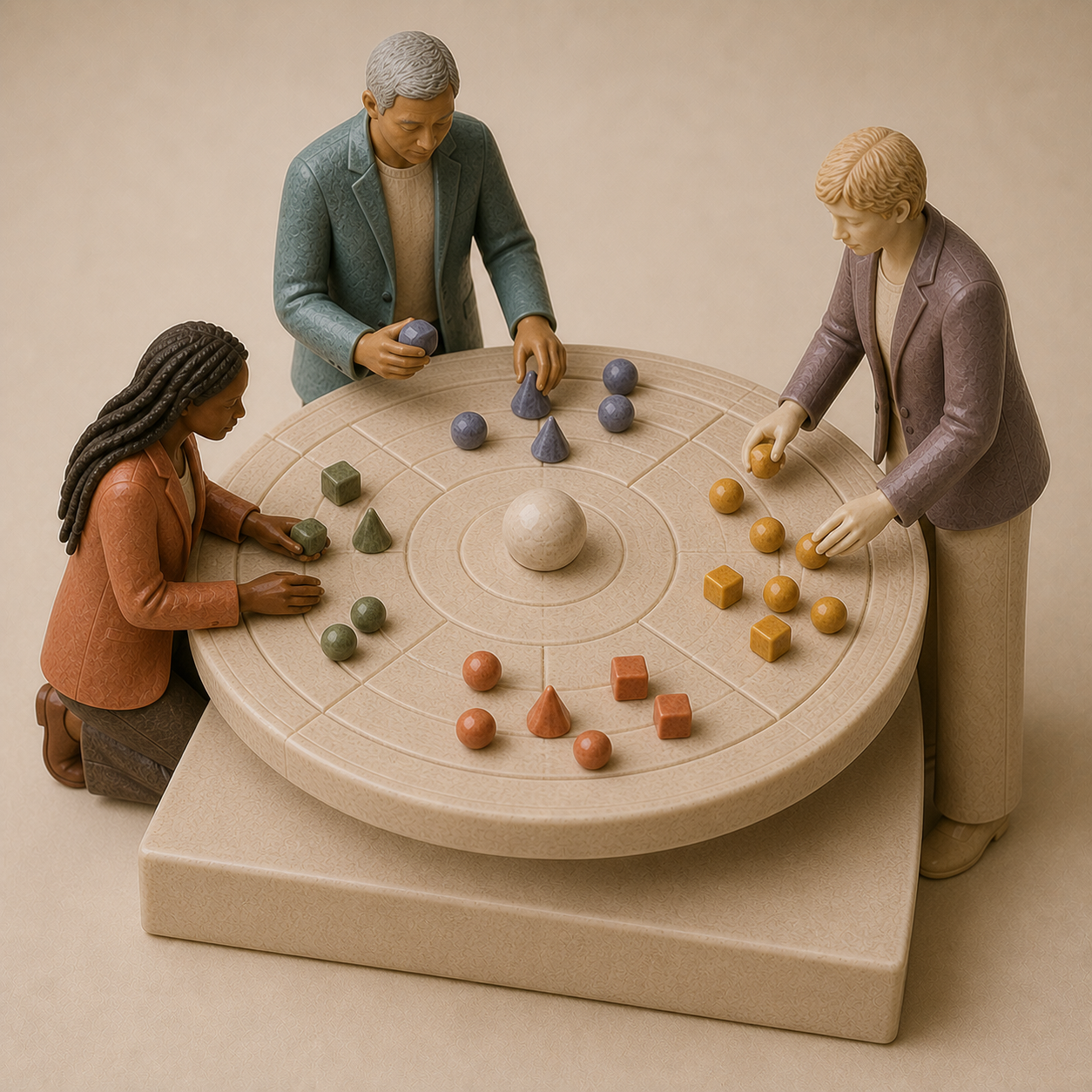
Small Things Are Big Things
How we show up in each interaction shapes the experience and the impact it creates.
What's Needed Emerges
By listening closely and staying flexible, what is needed becomes clearer over time.
Phase One
Grounding
Establish the vessel and shared truth
Grounding creates the container for the work. Before movement accelerates, leaders and teams need a transparent view of what is true, what is being asked of the system, and what conditions are required to begin.
This phase establishes the vessel, builds shared truth, and creates enough stability for people to stay oriented as strategy moves closer to practice.
Phase Two
Reconfiguring
Shape new operating conditions and decision pathways
Reconfiguring adjusts the system around the strategy. This is where operating conditions, decision pathways, role expectations, and tension diagnostics are made visible and redesigned where needed.
The aim is not disruption for its own sake. It is to remove friction, clarify authority, and create conditions that can carry the work as it becomes more concrete.
Phase Three
Practicing
Test the work through safe-to-fail experience
Practicing brings the new conditions into real-time application. Teams test the work, learn from what happens, and adjust without treating every signal as failure.
This phase creates safe-to-fail experiences, strengthens delivery habits, and helps leaders see where the strategy is becoming lived behaviour and where the system still needs support.
Phase Three
New Operating Fabric
Embed the work in routines and learning loops
The new operating fabric is created when the work no longer depends on extraordinary effort. The conditions become embedded in routines, decisions, meetings, roles, and learning loops.
This phase helps the organization keep adapting without losing coherence. Strategy becomes part of how the organization works, learns, and renews itself over time.