


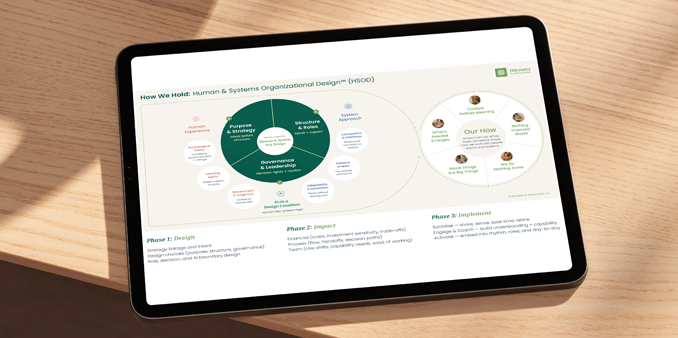
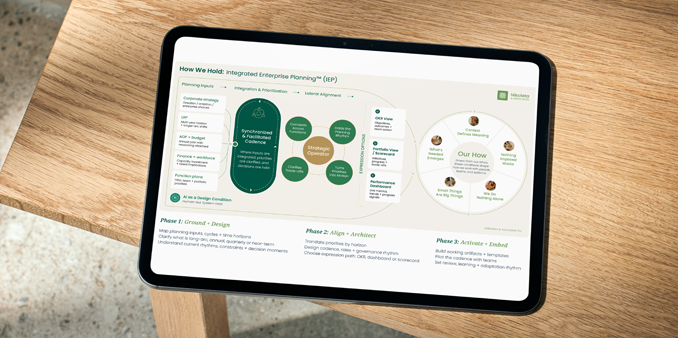

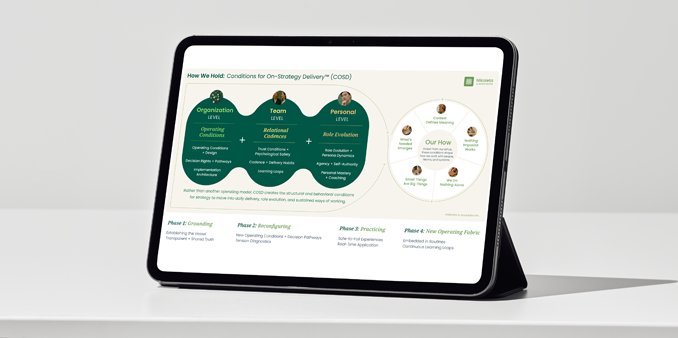


Strategy doesn't become real because a plan was written or a roadmap was set. It becomes real when an organization has an ongoing practice for keeping that direction connected to daily reality as circumstances shift. We hold this as three distinct but interconnected types of strategic work, each with its own purpose, pace, and rhythm.
Developing Strategy is the periodic work of defining direction, ambition, and the choices that will shape an organization's future.
It is a focused process with a clear beginning, end, and set of decisions. Planning is the work of translating that direction into coordinated action, connecting priorities across functions in whatever model, centralized or distributed, fits the organization. Strategic Facilitation is the ongoing practice that allows the other two to remain connected over time, creating the conditions for people to interpret direction, navigate what emerges, and adapt as the work evolves.
Though listed sequentially, these three types of work are rarely linear. Many organizations are engaged in some version of all three at once, moving at different rhythms and levels. Each has its own purpose, but they are most effective when held together as an integrated practice. Strategic Facilitation is what keeps that integration alive, working continuously to keep strategy connected to the business.
Underneath these three types of work sits a consistent set of commitments we hold as our Ethos. Context Defines Meaning: we treat existing plans, commitments, and history as essential ingredients, and our first commitment is always to listen before recommending anything new.
Nothing Imposed Works: a starting frame is a point we expect to adjust once we're working alongside the people who will live with it, with pacing shaped by the organization's own calendar and realities. We Do Nothing Alone: strategy is co-authored, and our role is to design the conditions where the right voices can shape the plan organically themselves. Small Things Are Big Things: the sequence of conversations, the cadence of communication, and the choice of words all carry the dynamics that shape how people experience change. What's Needed Emerges: this work is a process of discovery as much as delivery, and we stay open to what surfaces along the way.
Sustaining that momentum means treating strategy as an iterative practice rather than a fixed plan. Even a five-year strategy has to be translated into decisions that can be tested and refined as the organization learns. Finally, “good enough, keep moving” isn't a lowered bar; it's an intentional operating philosophy that keeps momentum as the through-line, and it's how strategy is operationalized into a living practice rather than a static document.


