
How We Hold
Modern Ways of Working
Aligning on What Matters, Advancing What’s Next
What is How We Hold?
“How We Hold” is a collection of creative pieces from our Around the Organization practice. Each piece reflects our approach to shaping leadership and organizational capability—designed to support deeper understanding and forward movement in both thinking and action.
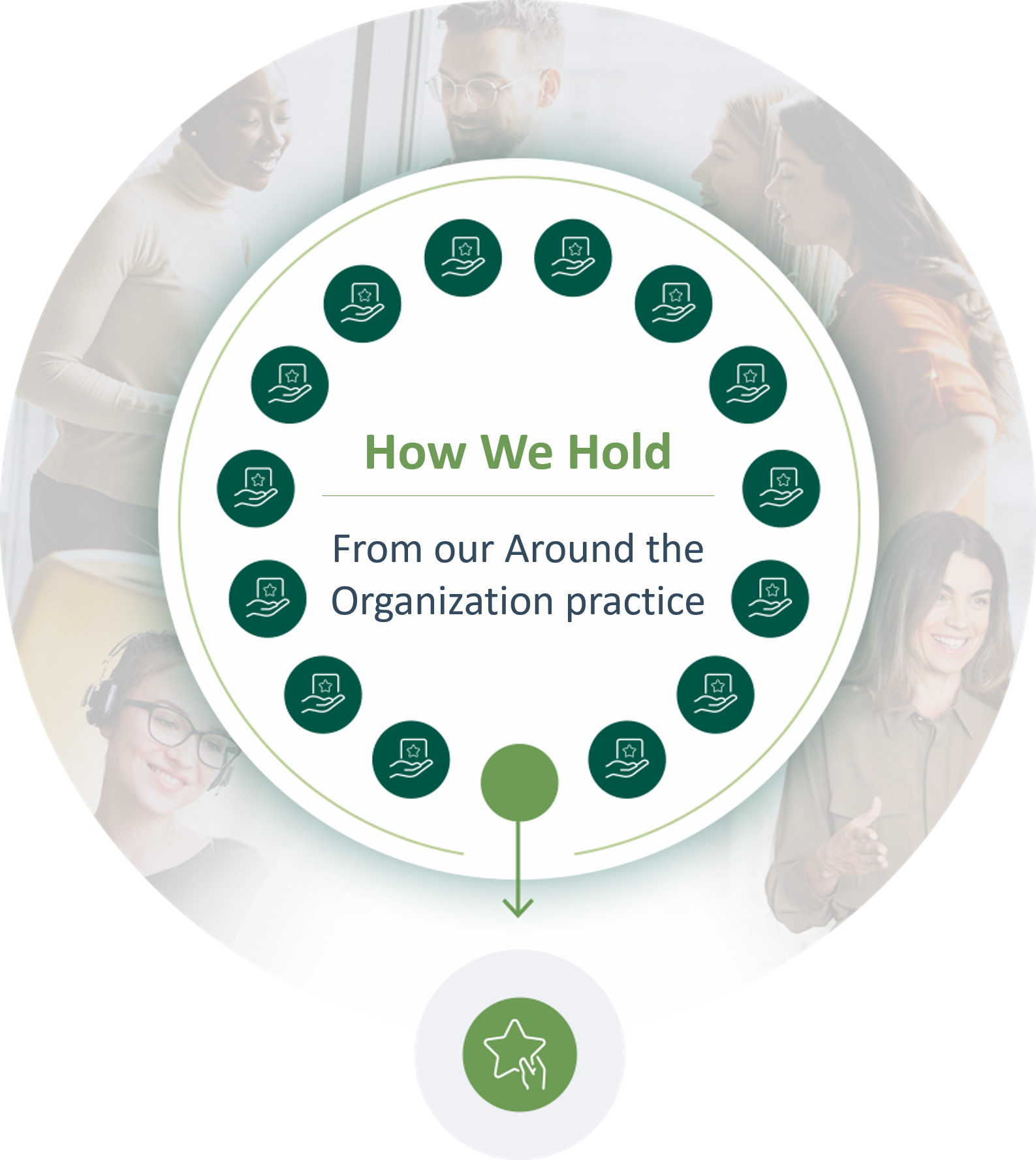
How We Hold
Modern Ways of Working
How we Hold Modern Ways of Working is designed to build organizational agility and strategic alignment in today’s dynamic markets. It is grounded in three core areas:
- Democratization of Data
- Dynamic Leadership & Decision-Making
- Organization & Culture
This approach supports teams to adapt and evolve, creating space for learning while using technology to deliver value more effectively. By moving from rigid processes to adaptive, outcome-focused strategies, it builds a steady rhythm—keeping the big picture in view while advancing meaningful day-to-day action.
How We Hold Modern Ways of Working
Primary Buckets
A three-part structure to contemplate the Modern Way of Working, with full understanding that all is integrated and wants to be considered as such when designing for implementation.
Tools & Technology
With the ever-evolving suite of tools, not limited to this accelerated era of Generative AI, it is important to know what is current, choose thoughtfully what to pilot and test to embed, and take the time to consider the outcomes and why.
Re-framing Traditional Change
Reframing change to build valuable organization and leadership capability is how Nikoleta & Associates lands the outcomes. Generally, shifting perspectives to view change as continuous + offering unlock opportunities to grow if enabled by coaching strategies.
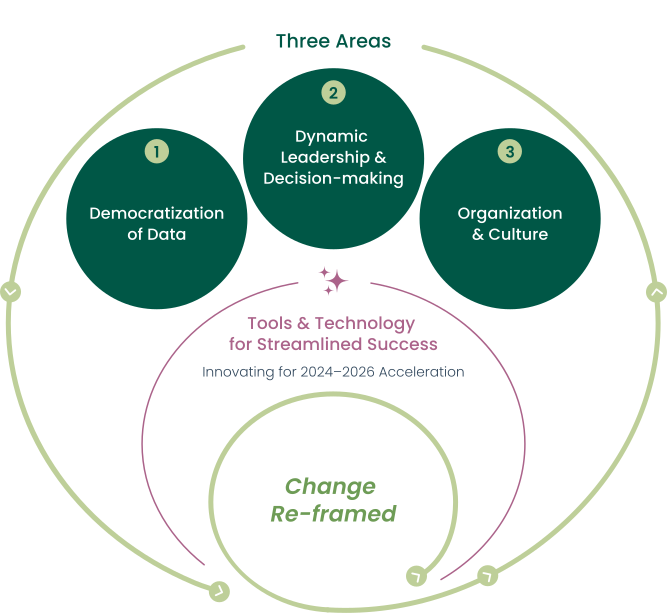
Modern Ways of Working Three Areas
1
Democratization of Data
Making information readily available within organizations to empower data-driven decision making, create collaboration and accelerate innovation in dynamic markets.
Transparency & Trust: Accessible data builds trust and collaboration
Data Literacy: Skills for data interpretation and application
Governance: Strategic framework & decision processes
Quality Control: Current, accurate data through stewardship
Security: Ethical boundaries and data protection
Mindful Use: Effective filtering and prioritization
2
Dynamic Leadership & Decision Making
Adaptable leadership approaches that emphasize coaching, emotional awareness, and strategic discretion while maintaining clarity of vision during organizational evolution.
Adaptability: Flexibility while maintaining vision clarity
Healthy Change: phased approach with renewal time
Human Skills: Coaching, empathy, and emotional awareness
Context: Understanding the what, why and who
Strategy: Insight prioritization and trend alignment
3
Organization & Culture
Creating environments that prioritize continuous learning, customer-centricity, and organizational growing edges while building capability for future paths.
Learning: Growth mindset and experimentation
Customer Focus: Data insights and human understanding
Innovation: Capability building in key areas
Growing Edges: Moments of learning and growth
Resilience: Dynamic processes for future challenges
Framing Modern Ways of Working
Key Principles of Modern Ways of Working
- Emphasizing adaptability, collaboration, and continuous improvement.
- Prioritizing customer outcomes and value delivery over rigid processes.
- Leveraging technology and tools to streamline operations.

Key Differences from
Traditional Approaches
1
Governance
Transitioning from centralized, top-down decision-making to decentralized, autonomous teams.
2
Processes
Moving away from rigid steps to iterative progress and experimentation, guided by first-principle thinking.
3
Change Management
Shifting from directive-based approaches to co-creation and ‘stakeholder-driven’ models.
Challenges Organizations Typically Face
- The culture change required.
- Designing for the integration of flexibility + accountability.
- Planning for legacy systems alongside modern tools.

Driving innovation through flexibility and customer-centric approaches.
Empowering teams with autonomy
to adapt and iterate quickly.
Effectively engaging the culture as the base and architecture of way of working.
What Modern Ways of Working Is Shaping Up to Be
This modern approach emphasizes adaptability, collaboration, and value-driven
outcomes ,enabled by technology, and flexibility.
A
Outcome-Focused
What it is: Delivering customer value quickly through iterative processes, emphasizing measurable results over rigid adherence to methods.
What it’s not: Using Agile sprints to launch a minimum viable product (MVP), gather feedback, and improve iteratively.
B
Collaborative and Decentralized
What it is: Empowering teams to make decisions within strategic boundaries and fostering cross-functional collaboration over silos.
What it’s not: A product team prioritizing features based on customer feedback without waiting for top-down approval.
C
Dynamic and Adaptive
What it is: Responding to changes quickly instead of rigidly following pre-defined plans, encouraging experimentation and learning.
What it’s not: Adjusting a marketing campaign mid-way based on real-time analytics and customer engagement.
D
Technology-Enabled
What it is: Leveraging modern tools to enhance automation, collaboration, and data-driven decision-making.
What it’s not: Using platforms like Azure DevOps, ChatGPT, or JIRA with Confluence to streamline workflows and improve communication.
What Modern Ways of Working Conceptual Examples
This thinking focuses on adaptability, efficiency, and value-driven operations while
moving away from rigidity, inefficiency, and over-reliance on a single methodology.
A
Hybrid Approach to Project Management
What it is: Combining Agile for product innovation with Waterfall for regulatory approval phases.
What it’s not: Applying Agile to projects requiring fixed timelines.
B
Lean Governance
Model
What it is: Enabling real-time decisions through continuous feedback loops.
What it’s not: Relying on traditional governance with sequential approval delays (e.g., Change Advisory Boards).
C
Team
Empowerment
What it is: Granting teams decision-making authority within strategic guardrails.
What it’s not: Depending on managers alone to set priorities and allocate tasks.
D
Continuous Learning and Improvement
What it is: Embedding regular retrospectives and feedback sessions to identify opportunities for growth and enhance processes over time.
What it’s not: Sticking to static processes without assessing their effectiveness or making improvements.
What Modern Ways of Working
Is Not
1
Process-Driven
Does not rely on rigid frameworks, such as strict Waterfall, for all projects.
Simplifies workflows by avoiding unnecessary documentation or approvals for small, ‘low-risk’ decisions.
2
Hierarchical + Bureaucratic
Does not rely on rigid frameworks, such as strict Waterfall, for all projects.
Removes the need for multiple layers of approval for minor adjustments to project scope.
3
One-Size-Fits-All
Adopts hybrid approaches over single methodologies like Agile or Waterfall, tailored to project needs.
Generally uses Agile for innovation-driven projects and Waterfall for ‘compliance-heavy’ initiatives.
4
Meeting-Centric
Reduces reliance on ‘governance-heavy’ meetings, focusing on actionable, outcome-driven communication.
Replaces weekly status meetings with asynchronous updates via tools like Confluence, Slack, Coda etc.